How to start an SMM panel business? You can do it in two ways: rent a child panel that runs on an existing provider under your own brand, or run your own panel script on your own server and connect it to one or more providers by API. Either way, the business itself is the same: you buy social media services at wholesale rates, sell them at a markup, and earn the difference, while handling customers, payments and support.
This guide walks through the model, the real costs, the setup steps and the risks, without income promises. If you are new to panels, start with what an SMM panel is.
How an SMM panel business makes money
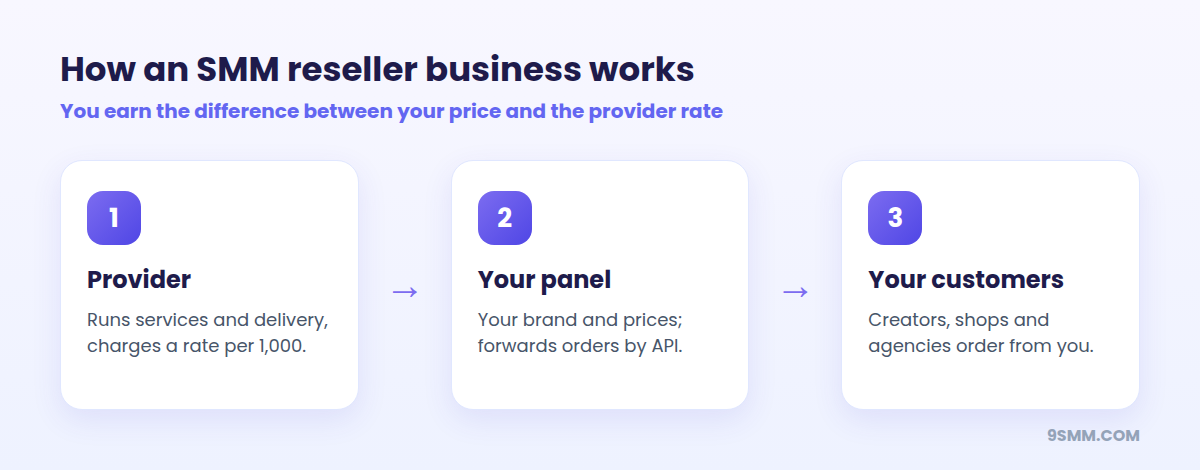
An SMM reseller sits between a provider and end customers:
- The provider (for example 9SMM.COM) runs the services and delivery, and charges a rate per 1,000 units.
- Your panel lists those services at your own price, takes payments from your customers and forwards each order to the provider automatically.
- Your customers (creators, small businesses, agencies, other resellers) order through your website and never see the provider.
Your gross margin on each order is your selling price minus the provider's price. Out of that margin you pay for everything else: the panel itself, payment fees, advertising, refunds you choose to absorb, and your own time on support.
A simple way to sanity-check a plan is to work backwards from your fixed costs. If your panel and tools cost $X per month and your average markup earns $Y per order, you need X ÷ Y orders a month just to break even. The SMM reseller profit calculator does this arithmetic across several services.
Option 1: rent a child panel
A child panel is a complete SMM website on your domain, selling a parent panel's catalogue at the parent's rates plus a markup you set. On 9SMM.COM, a child panel includes:
- your own domain, name and logo (customers do not see the parent brand);
- the full service catalogue, ready to sell from day one;
- automatic order delivery, hosting and updates;
- an admin dashboard for users, orders, balances and analytics;
- 8 built-in languages (English, Vietnamese, Hindi, Indonesian, Portuguese, Turkish, Arabic and Thai) and local currency display;
- a standard API v2 for your own customers.
Plans start from $10/month with no auto-renewal. Availability can change; the child panel page shows whether new panels are currently being accepted.
Best for: people who want to test the business quickly, have no server or coding experience, and prefer to spend their time on marketing.
Trade-off: you depend on one parent catalogue and its pricing.
Option 2: run your own panel script
Here you buy or license a panel script, host it on your own server, and add one or more providers through their APIs.
Best for: operators who want full control over design, features and multiple suppliers.
Trade-offs: hosting, script licence, security updates, backups and debugging are all your job. A security hole or an outage becomes your customers' problem, and yours.
We compare both routes in detail, with cost tables, in child panel vs your own panel.
How to start an SMM panel business, step by step
1. Choose a niche and a market
"Cheap SMM panel" is one of the most crowded searches there is. You will find it easier to start with a clear angle: one country or language, one platform (for example TikTok services for local sellers), or one customer type (agencies that want white-label reporting).
2. Pick and test a provider
Before you build anything, open an account with the provider you plan to resell and run small test orders on the services you want to sell. Check start counts, delivery speed and drops after a week. Use the same checklist a customer would: how to choose the best SMM panel.
Things that matter specifically to resellers:
- a standard API v2 (services, add, status, refill, cancel, balance);
- API prices equal to website prices;
- refill and cancel flags per service, so you can offer the same buttons to your customers;
- batch status checks (9SMM.COM accepts up to 100 order IDs per call) and a published rate limit.
Full details for integrators are on the SMM provider page and in the API documentation.
3. Set your prices
Import the service list, then set a markup per category. Common mistakes:
- a flat markup on everything, which makes cheap view services look expensive and expensive follower services look cheap;
- pricing below your provider after payment fees;
- ignoring refills. Services with refill cost more, but they generate fewer complaints.
4. Set up payments and policies
Decide which payment methods you accept, the minimum deposit and whether deposits are credited automatically. Then write down your rules before your first customer asks: when partial and canceled orders are refunded, whether refunds go to balance, and how refills work. You can model them on a clear policy such as our refund policy.
5. Fund your provider balance
Your customers pay you; you pay the provider. Every order your panel forwards is charged from your provider balance at the moment it is placed, so keep enough funds to cover a normal day of orders. 9SMM.COM adds a deposit bonus on larger top-ups ($10 or more +3%, $50 or more +5%, $100 or more +10%, $500 or more +15%).
6. Launch, then market honestly
A panel with no traffic sells nothing. Realistic channels are content (guides and tutorials in your language), communities where your customers already are, and word of mouth from resellers you serve well. Avoid promising "100% safe" or "no drop ever": it attracts complaints and damages trust.
Risks you should plan for
- Platform rules. Social networks prohibit artificial engagement. Your customers carry that risk, and you should tell them. Point them to is it safe to use an SMM panel.
- Drops and disputes. Some delivered numbers will drop. Clear refill rules and good order data (start count, remains) settle most disputes.
- Provider dependency. If your only provider changes a price or disables a service, your catalogue changes too. Watch the provider's update log.
- Payment chargebacks and fraud. Card and wallet disputes can arrive after the service is delivered. Choose payment methods with that in mind.
- Local law and tax. Running a paid online service is a business. Check what registration and tax rules apply where you live.
Frequently asked questions
How much does it cost to start an SMM panel?
With a child panel, the fixed cost is the monthly plan (from $10/month on 9SMM.COM) plus a domain and the balance you keep with the provider. With your own script, add hosting, the script licence and your time for maintenance.
Do I need coding skills?
Not for a child panel: hosting, updates and delivery are handled for you. Running your own script usually needs at least basic server and PHP or Node.js skills.
How do SMM resellers make money?
By selling each service above the provider's rate. The margin has to cover the panel, payment fees, marketing and support before it is profit.
Can I connect my existing panel to 9SMM.COM?
Yes. Add 9SMM.COM as a provider using its standard API v2 URL and your API key, then import services with action=services.
Is an SMM panel business legal?
Selling a digital service is generally legal, but buying engagement breaks most platforms' terms, and business registration and tax rules depend on your country. This is not legal advice; check local requirements.